
The numbers behind Japan’s flag football ambitions
Japan’s football federation reports barely 13,000 registered athletes. The small domestic base helps explain why trouble in its leading tackle league also matters to flag football.
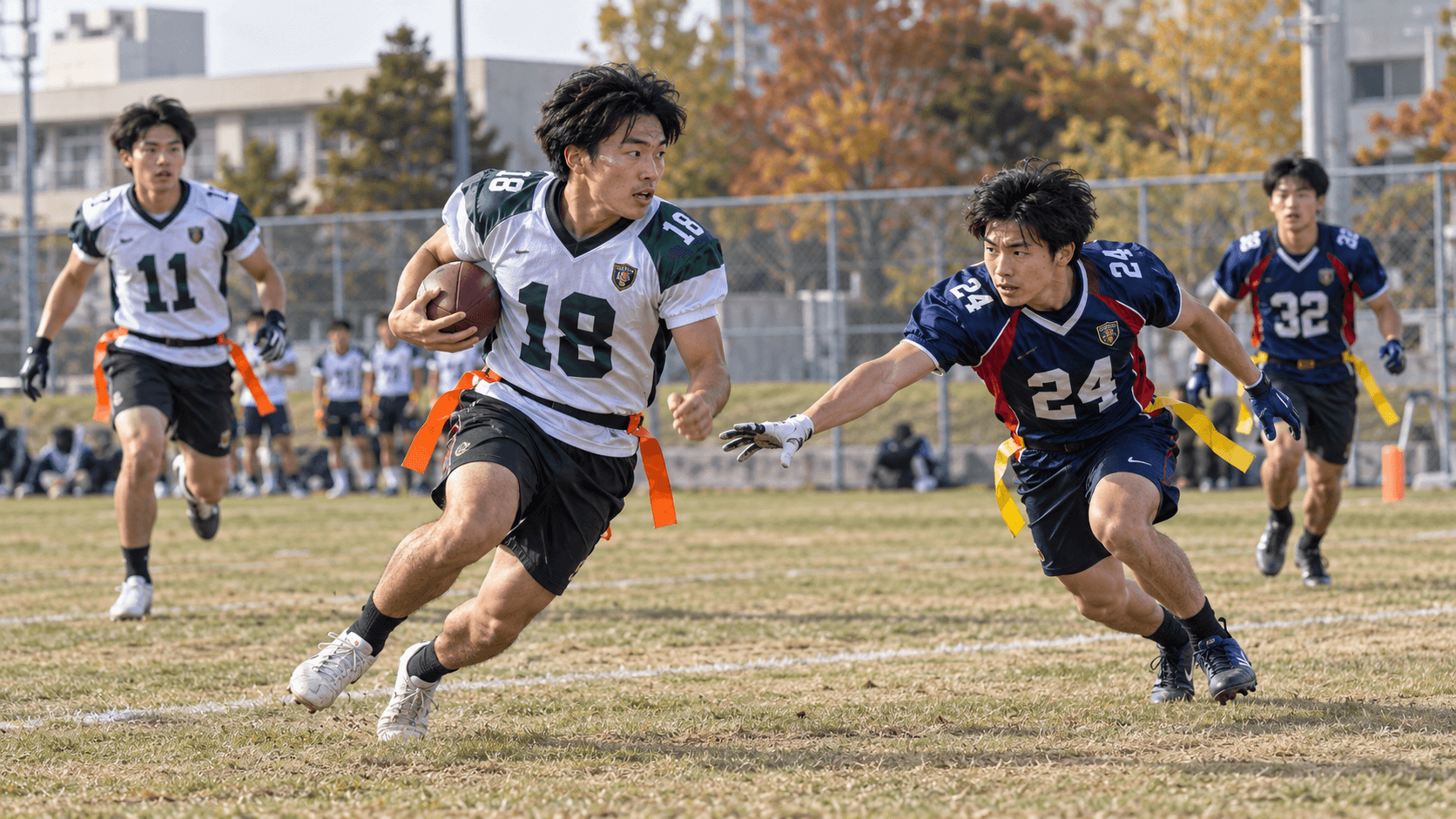
In Japan, flag football and tackle football share a national governing body. Its registration figures have fallen while soccer and basketball have built much larger player bases. That is the backdrop to a dispute in Japan’s leading tackle league, and a concern for flag’s development ahead of LA28.
Reporting note:Based on public sources available through October 30, 2026. Registration totals do not count everyone who plays, and reporting dates and coverage differ. JAFA’s published total does not separate tackle and flag football.
The domestic game behind Japan’s national teams
Japan’s population stood at roughly 124 million in 2024, yet its national football federation reported just 13,387 registered athletes in that year’s Sasakawa Sports Foundation survey.[1][2] That small domestic base is part of the context for Japan’s ambitions as flag football approaches its Olympic debut.
The Japan American Football Association (JAFA) oversees both tackle and flag football, including the flag national teams and national championships.[3] The X League, Japan’s top adult tackle league, is run by a separate organization, the National Football Association (NFA), which is affiliated with JAFA.[4][5] A dispute in the X League therefore concerns the wider football community, even though the league does not run the flag national teams.
Soccer has 63 times as many registered players
The scale difference is clearest alongside other Japanese ball sports. In fiscal 2024, soccer had 838,657 registered players and basketball 580,326, about 63 and 43 times JAFA’s total respectively.[6][7]
Even handball had 74,562 registrations in the Sasakawa survey, about 5.6 times as many. Rubber-ball baseball alone had 580,741.[2] That is a form of baseball played with a rubber ball rather than a conventional hardball; the figure is not a count of all baseball players in Japan.
Flag football itself has a smaller registered base still. In an April 2026 interview with Nagoya TV, national-team player Tomoka Kawaguchi put Japan’s registered flag players at about 3,000.[8] That figure is distinct from the number of children who encounter flag in school PE or people who play casually.
| Sport or federation | Registered athletes |
|---|---|
| American football (JAFA) | 13,387 [2] |
| Soccer | 838,657 [6] |
| Basketball | 580,326 [7] |
| Rubber-ball baseball | 580,741 [2] |
| Handball | 74,562 [2] |
Twenty-five years without a larger base
JAFA’s own history records 15,649 registrants in 2000, including 9,331 university players.[9] The 2010 Sasakawa survey listed 19,552, so there was a period of growth.[10] But the total fell to 15,756 in 2020, 13,809 in 2022 and 13,387 in 2024.[11][12][2]
From 2020 to 2024 alone, the reported total dropped by 2,369, or about 15%. Japan’s declining child population and differences in registration coverage are part of the context, but this is still a disappointing direction for an already small game.
Other sports have built much deeper player bases over time. Soccer registrations rose from 309,731 in 1980 to 838,657 in 2024, about 2.7 times as many.[6] Basketball’s individual-registration series, introduced in 2000, went from 499,743 that year to 580,326 in 2024.[7][13] Football has failed to expand while an already large gap with those sports has widened.
| Year or survey | Registered athletes |
|---|---|
| 2000 historical record | 15,649 [9] |
| 2010 survey | 19,552 [10] |
| 2020 survey | 15,756 [11] |
| 2022 survey | 13,809 [12] |
| 2024 survey | 13,387 [2] |
Why a tackle-league dispute matters to flag
A dispute over how the X League classifies and limits professionally contracted players led to a boycotted game in September. Journalist Kazuto Oshima examined the league’s wider governance problems in an October 27 report for Gendai Business.[14] For readers outside Japan, the important context is that this conflict is taking place within a football community that has little room to shrink further.
There has since been a significant update. On October 29, the NFA announced that two Obic Seagulls players under continuing investigation did not meet its definition of professionally contracted players.[15] Obic nevertheless withdrew from its remaining games that season, citing the wider sequence of events, including earlier disciplinary cases, and the need to rebuild trust.[16]
This article does not judge the parties to that dispute or attempt to explain why football registrations have fallen. The concern for flag is the condition of the broader community it belongs to. A small game needs its clubs and governing bodies to cooperate on recruitment and development, rather than lose trust in one another.
Flag has opportunities that tackle does not
There are encouraging signs within Japanese flag football. Championship participation figures supplied by JAFA to REAL SPORTS show increases between 2019 and 2023: elementary-school entrants went from 1,091 to 1,813, junior-high entrants from 403 to 651, and women from 83 to 214.[17] These are tournament entries, not a national player census, but they show growth from a small starting point.
Flag’s rapid expansion as a girls’ sport in the United States is another source of momentum. U.S. high-school girls’ participation reached 102,360 in 2025-26, up 48.7% in a year.[18] LA28’s flag football debut, Japan’s inclusion of flag-based games in elementary-school PE guidance, and the NFL-backed professional league project also give flag opportunities that are distinct from the position of domestic tackle football.[19][20][21]
Japan’s tackle league has recognized the importance of youth development too. When the X Premier division was announced, a requirement for clubs to have kids’ and junior teams was presented as part of its development plan.[22]
Olympic attention and NFL investment will not, by themselves, build a larger Japanese playing base. The immediate task is to resolve the turmoil and let clubs, coaches and federations put their effort into recruiting and keeping players. Flag’s international opportunity is real; making it count in Japan requires cooperation at home.